O:9:"MagpieRSS":23:{s:6:"parser";i:0;s:12:"current_item";a:0:{}s:5:"items";a:10:{i:0;a:14:{s:5:"title";s:61:"Artemis I “Wet Test” To Happen in February NASA Announced";s:4:"link";s:91:"https://genesisblocknews.com/space/artemis-i-wet-test-to-happen-in-february-nasa-announced/";s:8:"comments";s:99:"https://genesisblocknews.com/space/artemis-i-wet-test-to-happen-in-february-nasa-announced/#respond";s:2:"dc";a:1:{s:7:"creator";s:10:"Susan Hall";}s:7:"pubdate";s:31:"Wed, 19 Jan 2022 22:05:51 +0000";s:8:"category";s:46:"SpaceAnnouncedArtemisFebruaryHappenNASAtestwet";s:4:"guid";s:90:"http://genesisblocknews.com/space/artemis-i-wet-test-to-happen-in-february-nasa-announced/";s:11:"description";s:637:"The first moon-bound rocket and spacecraft in NASA’s Artemis program are expected to do a “wet trial” on the launch pad in February, the agency said. Engineers for the mission, which is due to launch later this year, have subjected the mission’s hardware to a series of checks to ensure it is ready for the ... Read more";s:7:"content";a:1:{s:7:"encoded";s:3000:"
The first moon-bound rocket and spacecraft in NASA’s Artemis program are expected to do a “wet trial” on the launch pad in February, the agency said.
Engineers for the mission, which is due to launch later this year, have subjected the mission’s hardware to a series of checks to ensure it is ready for the milestone, which will be critical in determining Artemis 1’s readiness for flight.
Artemis 1 aims to send an unmanned spacecraft around the moon using a combination of the Space Launch System rocket, or SLS with the Orion spacecraft. Remembering that the set has never flown together before, Orion did a test in 2014 and the SLS never flew. NASA hopes to extend the program with the manned Artemis 2 mission into lunar orbit in 2024, then with a landing on Artemis 3 in 2025.
But getting ready for the launch pad requires a complex set of engineering tasks to ensure all the pieces are ready for the stress of spaceflight. NASA completed several checkpoints in the past month, the agency noted in two recent blog posts.
On Tuesday (January 11), the crew access arm of the Orion spacecraft was retracted and extended to ensure it functions properly, NASA said in a blog post Thursday (January 13).
The arm is intended to provide safe access for astronauts to the SLS rocket during missions and also serves technicians during assembly and test operations at the Vehicle Assembly Building (VAB) at NASA’s Kennedy Space Center in Florida. As for the SLS itself, on Friday (January 14) NASA reported that a “series of engineering tests” had been completed on the vehicle’s core booster, which is also inside the VAB.
The first task was to replace and test one of the four RS-25 engine controllers and then the team went on to ensure that the flight computers, engine controllers and main booster systems were communicating and working properly. Technicians also tested “gimbaling” or slightly moving the engines to simulate the movements they will perform during flight.
With everything going according to plan, the team plans to run its second countdown test “to demonstrate the ground launch software and ground launch sequencer, which checks the health and status of the vehicle while on the block,” it said. to NASA. The goal is to ensure that Orion and the SLS are responding as expected during the simulated countdown.
The stacked spacecraft and thruster will head to the nearby launch pad once the countdown test and final checks are complete, the agency noted, but has yet to provide a date for the transfer.
";}s:3:"wfw";a:1:{s:10:"commentrss";s:96:"https://genesisblocknews.com/space/artemis-i-wet-test-to-happen-in-february-nasa-announced/feed/";}s:5:"slash";a:1:{s:8:"comments";s:1:"0";}s:7:"summary";s:637:"The first moon-bound rocket and spacecraft in NASA’s Artemis program are expected to do a “wet trial” on the launch pad in February, the agency said. Engineers for the mission, which is due to launch later this year, have subjected the mission’s hardware to a series of checks to ensure it is ready for the ... Read more";s:12:"atom_content";s:3000:"
The first moon-bound rocket and spacecraft in NASA’s Artemis program are expected to do a “wet trial” on the launch pad in February, the agency said.
Engineers for the mission, which is due to launch later this year, have subjected the mission’s hardware to a series of checks to ensure it is ready for the milestone, which will be critical in determining Artemis 1’s readiness for flight.
Artemis 1 aims to send an unmanned spacecraft around the moon using a combination of the Space Launch System rocket, or SLS with the Orion spacecraft. Remembering that the set has never flown together before, Orion did a test in 2014 and the SLS never flew. NASA hopes to extend the program with the manned Artemis 2 mission into lunar orbit in 2024, then with a landing on Artemis 3 in 2025.
But getting ready for the launch pad requires a complex set of engineering tasks to ensure all the pieces are ready for the stress of spaceflight. NASA completed several checkpoints in the past month, the agency noted in two recent blog posts.
On Tuesday (January 11), the crew access arm of the Orion spacecraft was retracted and extended to ensure it functions properly, NASA said in a blog post Thursday (January 13).
The arm is intended to provide safe access for astronauts to the SLS rocket during missions and also serves technicians during assembly and test operations at the Vehicle Assembly Building (VAB) at NASA’s Kennedy Space Center in Florida. As for the SLS itself, on Friday (January 14) NASA reported that a “series of engineering tests” had been completed on the vehicle’s core booster, which is also inside the VAB.
The first task was to replace and test one of the four RS-25 engine controllers and then the team went on to ensure that the flight computers, engine controllers and main booster systems were communicating and working properly. Technicians also tested “gimbaling” or slightly moving the engines to simulate the movements they will perform during flight.
With everything going according to plan, the team plans to run its second countdown test “to demonstrate the ground launch software and ground launch sequencer, which checks the health and status of the vehicle while on the block,” it said. to NASA. The goal is to ensure that Orion and the SLS are responding as expected during the simulated countdown.
The stacked spacecraft and thruster will head to the nearby launch pad once the countdown test and final checks are complete, the agency noted, but has yet to provide a date for the transfer.
";s:14:"date_timestamp";i:1642629951;}i:1;a:14:{s:5:"title";s:80:"Executive Mosaic Announces 2022 Wash100 Award Winners; CEO Jim Garrettson Quoted";s:4:"link";s:115:"https://genesisblocknews.com/space/executive-mosaic-announces-2022-wash100-award-winners-ceo-jim-garrettson-quoted/";s:8:"comments";s:123:"https://genesisblocknews.com/space/executive-mosaic-announces-2022-wash100-award-winners-ceo-jim-garrettson-quoted/#respond";s:2:"dc";a:1:{s:7:"creator";s:10:"Susan Hall";}s:7:"pubdate";s:31:"Wed, 19 Jan 2022 20:35:46 +0000";s:8:"category";s:70:"SpaceannouncesAwardCEOexecutiveGarrettsonJimMosaicQuotedWash100Winners";s:4:"guid";s:114:"http://genesisblocknews.com/space/executive-mosaic-announces-2022-wash100-award-winners-ceo-jim-garrettson-quoted/";s:11:"description";s:714:"Executive Mosaic, the leading provider in connecting, promoting and branding government and government contracting (GovCon) executives of consequence, has announced the winners of the 2022 Wash100 Award, the most prestigious and coveted award in all of GovCon to recognize the 100 executives who will impact the sector in the coming year. The 2022 Wash100 Award ... Read more";s:7:"content";a:1:{s:7:"encoded";s:10215:"
Executive Mosaic, the leading provider in connecting, promoting and branding government and government contracting (GovCon) executives of consequence, has announced the winners of the 2022 Wash100 Award, the most prestigious and coveted award in all of GovCon to recognize the 100 executives who will impact the sector in the coming year.
The 2022 Wash100 Award acknowledges the accomplishments of this year’s winners over the past year and recognizes the potential that each awardee possesses heading into the new year to drive innovation as ongoing initiatives in policy, emerging technology and other crucial areas continue to heavily influence the federal landscape.
“For our ninth consecutive year, Executive Mosaic has completed our exhaustive search, and qualification process through thousands of executives in government and GovCon, in order to produce the annual Wash100 list of the elite of the elite,” said Jim Garrettson, founder and CEO of Executive Mosaic as well as the creator of the Wash100 Award.
“The intensive search for the exemplary executives is uniquely focused on a forward-looking assessment of performance leaders who will impact the market in the year ahead,” Garrettson continued. “We stand proudly upon our previous years of executive leadership assessment and invite the GovCon community to visit Wash100.com to see our successful predictions of the nation’s key GovCon and government executives.”
Executive Mosaic applied an additional lens of adaptability into how each of this year’s winners was selected. The winning executives are considered an essential part of the industry’s backbone that will ensure future continuity, stability of the GovCon industry and government operations throughout the current pandemic lifecycle.
Technology, supply chain, artificial intelligence, digital transformation, cyber security and multidomain capability/support were among the additional factors considered in this year‘s slope of increased difficulty of qualification.
Here are the esteemed recipients of the 2022 Wash100 Award:
Craig Abod – President of Carahsoft
Gen. Lloyd Austin – Secretary of Defense with DOD
Roy Azevedo – President of Raytheon Intelligence & Space
Dana Barnes – SVP of Public Sector Palo Alto Networks
Chris Brady – President of General Dynamics Mission Systems
Byron Bright – President of Government Solutions for KBR
Jim Brinker – President and General Manager of Intel Federal LLC
Christian Brose – Chief Strategy Officer for Anduril Industries
Dr. Reggie Brothers – CEO of BigBear.ai
Michael Brown – Director of the Defense Innovation Unit
William Burns – Director of the CIA
Bruce Caswell – President and CEO of Maximus
Jennifer Chronis – SVP of Public Sector of Verizon Federal
Clara Conti – SVP and General Manager of Red Hat
Lisa Costa – Chief Technology and Innovation Officer for the U.S. Space Force
Lt. Gen. Dennis Crall – Director of (C4) / Cyber; CIO Joint Staff, J6
Matt Desch – CEO of Iridium
Paul Dillahay – President and CEO of NCI Information Systems
Stacey Dixon – Principal Deputy Director of National Intelligence for ODNI
Tina Dolph – President and CEO of Siemens Government Technologies
Jen Easterly – Director of CISA
Steve Escaravage – Senior Vice President for Booz Allen Hamilton
Jennifer Ewbank – Deputy Director of Digital Innovation for the CIA
Gerry Fasano – President of Defense for Leidos
Mark Frantz – Co-founder of Blue Delta Capital Partners
Amy Gilliland – President of General Dynamics Information Technology
John Goodman – Chief Executive for Accenture Federal Services
James Gordon – President of Cognosante
Christopher Grady – Vice Chairman Nominee for the Joint Chiefs of Staff
DeEtte Gray – President, Business & IT Solutions for CACI
Andy Green – EVP of Huntington Ingalls Industries and President of HII’s Technical Solutions Division
Michael Groen – Director for the Joint Artificial Intelligence Center (JAIC)
Avril Haines – Director of ODNI
John Heneghan – President of ECS Federal
Kathleen Hicks – Deputy Secretary for the Department of Defense
Dawne Hickton – President of Critical Mission Solutions for Jacobs
Stephanie Hill – EVP of Rotary and Mission Systems for Lockheed Martin
John “Chris” Inglis – National Cyber Director for the Executive Office of the President
Raj Iyer – Chief Information Officer for the U.S. Army
Daniel Jablonsky – CEO of Maxar Technologies
David Jevans – CEO of CipherTrace
Rob Joyce – Director and Deputy National Manager for the Cybersecurity Directorate for NSA
Nazzic Keene – CEO of SAIC
Jim Kelly – SVP of Federal for Dell Technologies
Lauren Knausenberger – Chief Information Officer for the Department of the Air Force
Roger Krone – Chairman and CEO of Leidos
Doug Lane – CEO of Capgemini Government Solutions
William LaPlante – Nominee for Under Secretary for Acquisition and Sustainment for DOD
Michael LaRouche – President of National Security and Space Sector for SAIC
Robert Lightfoot – EVP of Space for Lockheed Martin
Stephanie Mango – President of CGI Federal
Clare Martorana – Chief Information Officer for the U.S. Office of Personnel Management
John McGinn – Executive Director for the Center for GovCon for George Mason University
Scott McIntyre – CEO of Guidehouse
John Mengucci – President and CEO of CACI
Bill Monet – President and CEO of Akima
Jonathan Moneymaker – CEO of BlueHalo
Pat Mungovan – Senior Vice President of Oracle Public Sector
Ramzi Musallam – CEO and Managing Partner of Veritas Capital
Gen. Paul Nakasone – Director, NSA, and Commander, USCyberComm
Phebe Novakovic – Chairman and CEO of General Dynamics
Deniece Peterson – Senior Director, Federal Market Analysis for Deltek
Max Peterson – VP, WW Public Sector with Amazon Web Services
Mary Petryszyn – CVP and President of Defense Systems for Northrop Grumman
Kevin Phillips – Chairman, CEO and President for ManTech
Kevin Plexico – Senior Vice President of Information Solutions for Deltek
Jason Porter – President of Public Sector and FirstNet for AT&T
Todd Probert – President, National Security and Innovative Solutions for CACI
Jason Providakes – President and CEO of MITRE
Chuck Prow – President and CEO of Vectrus
Shawn Purvis – President and CEO for QinetiQ North America, Inc
Gen. John Raymond – Chief of Space Operations OSCO for the Department of the Air Force
Anthony Robbins – VP of Federal for NVIDIA
Christopher Scolese – Director of the National Reconnaissance Office
Stu Shea – Chairman, President, CEO for Peraton
John Sherman – Chief Information Officer for the Department of Defense
Heidi Shyu – Under Secretary for the Office of the Under Secretary of Defense for R&E
Robert Skinner – Director for the Defense Information Systems Agency
Stevan Slijepcevic – CEO for Cubic Mission and Performance Solutions
Carey Smith – President and CEO of Parsons
Jean Stack – Managing Director for Baird
Jim Taiclet – President and CEO of Lockheed Martin
Haywood Talcove – CEO of Government for LexisNexis Risk Solutions
Mark Testoni – CEO and Member of the Board of Directors for SAP National Security Services
Stefanie Tompkins – Director of the Defense Advanced Research Projects Agency
Vincent Vlasho – Managing Director of Defense & Intelligence for Accenture Federal Services
John Vollmer – CEO of Amentum
Lou Von Thaer – President and CEO of Battelle
Rick Wagner – President of Microsoft Federal
Doug Wagoner – President and CEO of LMI
Kathy Warden – Chairman, CEO and President of Northrop Grumman
Teresa Weipert – General Manager of Federal for Maximus
Aaron Weis – Chief Information Officer for the Department of Navy
Greg Wenzel – Executive Vice President for Booz Allen Hamilton
Al Whitmore – President, Intelligence & Security (I&S) for BAE Systems
Vice Adm. Frank Whitworth – NGA Director (Nominated)
Tonya Wilkerson – Deputy Director for the NGA
David Young – SVP of Public Sector for Lumen Technologies
John Zangardi – President of Redhorse Corporation
Juan Zarate – Global Co-Managing Partner and Chief Strategy Officer for K2 Integrity
After last year’s record-shattering Wash100 Popular Vote saw the GovCon community submit more than 36,000 votes, the anticipation for this year’s Wash100 Award season has reached an all-time high heading into 2022. Executive Mosaic expects this Wash100 Award season to reach new heights and receive the largest turnout of support in the nine-year history of the award.
Executive Mosaic will begin to feature an in-depth profile for each 2022 Wash100 Award recipient starting Jan. 24th on GovCon Wire and ExecutiveBiz every day at 6 a.m. and 12 p.m., respectively, to recognize their accomplishments over the past year and set the stage for their success over the coming year. Stay tuned for more news and information about Wash100 voting!
";}s:3:"wfw";a:1:{s:10:"commentrss";s:120:"https://genesisblocknews.com/space/executive-mosaic-announces-2022-wash100-award-winners-ceo-jim-garrettson-quoted/feed/";}s:5:"slash";a:1:{s:8:"comments";s:1:"0";}s:7:"summary";s:714:"Executive Mosaic, the leading provider in connecting, promoting and branding government and government contracting (GovCon) executives of consequence, has announced the winners of the 2022 Wash100 Award, the most prestigious and coveted award in all of GovCon to recognize the 100 executives who will impact the sector in the coming year. The 2022 Wash100 Award ... Read more";s:12:"atom_content";s:10215:"
Executive Mosaic, the leading provider in connecting, promoting and branding government and government contracting (GovCon) executives of consequence, has announced the winners of the 2022 Wash100 Award, the most prestigious and coveted award in all of GovCon to recognize the 100 executives who will impact the sector in the coming year.
The 2022 Wash100 Award acknowledges the accomplishments of this year’s winners over the past year and recognizes the potential that each awardee possesses heading into the new year to drive innovation as ongoing initiatives in policy, emerging technology and other crucial areas continue to heavily influence the federal landscape.
“For our ninth consecutive year, Executive Mosaic has completed our exhaustive search, and qualification process through thousands of executives in government and GovCon, in order to produce the annual Wash100 list of the elite of the elite,” said Jim Garrettson, founder and CEO of Executive Mosaic as well as the creator of the Wash100 Award.
“The intensive search for the exemplary executives is uniquely focused on a forward-looking assessment of performance leaders who will impact the market in the year ahead,” Garrettson continued. “We stand proudly upon our previous years of executive leadership assessment and invite the GovCon community to visit Wash100.com to see our successful predictions of the nation’s key GovCon and government executives.”
Executive Mosaic applied an additional lens of adaptability into how each of this year’s winners was selected. The winning executives are considered an essential part of the industry’s backbone that will ensure future continuity, stability of the GovCon industry and government operations throughout the current pandemic lifecycle.
Technology, supply chain, artificial intelligence, digital transformation, cyber security and multidomain capability/support were among the additional factors considered in this year‘s slope of increased difficulty of qualification.
Here are the esteemed recipients of the 2022 Wash100 Award:
Craig Abod – President of Carahsoft
Gen. Lloyd Austin – Secretary of Defense with DOD
Roy Azevedo – President of Raytheon Intelligence & Space
Dana Barnes – SVP of Public Sector Palo Alto Networks
Chris Brady – President of General Dynamics Mission Systems
Byron Bright – President of Government Solutions for KBR
Jim Brinker – President and General Manager of Intel Federal LLC
Christian Brose – Chief Strategy Officer for Anduril Industries
Dr. Reggie Brothers – CEO of BigBear.ai
Michael Brown – Director of the Defense Innovation Unit
William Burns – Director of the CIA
Bruce Caswell – President and CEO of Maximus
Jennifer Chronis – SVP of Public Sector of Verizon Federal
Clara Conti – SVP and General Manager of Red Hat
Lisa Costa – Chief Technology and Innovation Officer for the U.S. Space Force
Lt. Gen. Dennis Crall – Director of (C4) / Cyber; CIO Joint Staff, J6
Matt Desch – CEO of Iridium
Paul Dillahay – President and CEO of NCI Information Systems
Stacey Dixon – Principal Deputy Director of National Intelligence for ODNI
Tina Dolph – President and CEO of Siemens Government Technologies
Jen Easterly – Director of CISA
Steve Escaravage – Senior Vice President for Booz Allen Hamilton
Jennifer Ewbank – Deputy Director of Digital Innovation for the CIA
Gerry Fasano – President of Defense for Leidos
Mark Frantz – Co-founder of Blue Delta Capital Partners
Amy Gilliland – President of General Dynamics Information Technology
John Goodman – Chief Executive for Accenture Federal Services
James Gordon – President of Cognosante
Christopher Grady – Vice Chairman Nominee for the Joint Chiefs of Staff
DeEtte Gray – President, Business & IT Solutions for CACI
Andy Green – EVP of Huntington Ingalls Industries and President of HII’s Technical Solutions Division
Michael Groen – Director for the Joint Artificial Intelligence Center (JAIC)
Avril Haines – Director of ODNI
John Heneghan – President of ECS Federal
Kathleen Hicks – Deputy Secretary for the Department of Defense
Dawne Hickton – President of Critical Mission Solutions for Jacobs
Stephanie Hill – EVP of Rotary and Mission Systems for Lockheed Martin
John “Chris” Inglis – National Cyber Director for the Executive Office of the President
Raj Iyer – Chief Information Officer for the U.S. Army
Daniel Jablonsky – CEO of Maxar Technologies
David Jevans – CEO of CipherTrace
Rob Joyce – Director and Deputy National Manager for the Cybersecurity Directorate for NSA
Nazzic Keene – CEO of SAIC
Jim Kelly – SVP of Federal for Dell Technologies
Lauren Knausenberger – Chief Information Officer for the Department of the Air Force
Roger Krone – Chairman and CEO of Leidos
Doug Lane – CEO of Capgemini Government Solutions
William LaPlante – Nominee for Under Secretary for Acquisition and Sustainment for DOD
Michael LaRouche – President of National Security and Space Sector for SAIC
Robert Lightfoot – EVP of Space for Lockheed Martin
Stephanie Mango – President of CGI Federal
Clare Martorana – Chief Information Officer for the U.S. Office of Personnel Management
John McGinn – Executive Director for the Center for GovCon for George Mason University
Scott McIntyre – CEO of Guidehouse
John Mengucci – President and CEO of CACI
Bill Monet – President and CEO of Akima
Jonathan Moneymaker – CEO of BlueHalo
Pat Mungovan – Senior Vice President of Oracle Public Sector
Ramzi Musallam – CEO and Managing Partner of Veritas Capital
Gen. Paul Nakasone – Director, NSA, and Commander, USCyberComm
Phebe Novakovic – Chairman and CEO of General Dynamics
Deniece Peterson – Senior Director, Federal Market Analysis for Deltek
Max Peterson – VP, WW Public Sector with Amazon Web Services
Mary Petryszyn – CVP and President of Defense Systems for Northrop Grumman
Kevin Phillips – Chairman, CEO and President for ManTech
Kevin Plexico – Senior Vice President of Information Solutions for Deltek
Jason Porter – President of Public Sector and FirstNet for AT&T
Todd Probert – President, National Security and Innovative Solutions for CACI
Jason Providakes – President and CEO of MITRE
Chuck Prow – President and CEO of Vectrus
Shawn Purvis – President and CEO for QinetiQ North America, Inc
Gen. John Raymond – Chief of Space Operations OSCO for the Department of the Air Force
Anthony Robbins – VP of Federal for NVIDIA
Christopher Scolese – Director of the National Reconnaissance Office
Stu Shea – Chairman, President, CEO for Peraton
John Sherman – Chief Information Officer for the Department of Defense
Heidi Shyu – Under Secretary for the Office of the Under Secretary of Defense for R&E
Robert Skinner – Director for the Defense Information Systems Agency
Stevan Slijepcevic – CEO for Cubic Mission and Performance Solutions
Carey Smith – President and CEO of Parsons
Jean Stack – Managing Director for Baird
Jim Taiclet – President and CEO of Lockheed Martin
Haywood Talcove – CEO of Government for LexisNexis Risk Solutions
Mark Testoni – CEO and Member of the Board of Directors for SAP National Security Services
Stefanie Tompkins – Director of the Defense Advanced Research Projects Agency
Vincent Vlasho – Managing Director of Defense & Intelligence for Accenture Federal Services
John Vollmer – CEO of Amentum
Lou Von Thaer – President and CEO of Battelle
Rick Wagner – President of Microsoft Federal
Doug Wagoner – President and CEO of LMI
Kathy Warden – Chairman, CEO and President of Northrop Grumman
Teresa Weipert – General Manager of Federal for Maximus
Aaron Weis – Chief Information Officer for the Department of Navy
Greg Wenzel – Executive Vice President for Booz Allen Hamilton
Al Whitmore – President, Intelligence & Security (I&S) for BAE Systems
Vice Adm. Frank Whitworth – NGA Director (Nominated)
Tonya Wilkerson – Deputy Director for the NGA
David Young – SVP of Public Sector for Lumen Technologies
John Zangardi – President of Redhorse Corporation
Juan Zarate – Global Co-Managing Partner and Chief Strategy Officer for K2 Integrity
After last year’s record-shattering Wash100 Popular Vote saw the GovCon community submit more than 36,000 votes, the anticipation for this year’s Wash100 Award season has reached an all-time high heading into 2022. Executive Mosaic expects this Wash100 Award season to reach new heights and receive the largest turnout of support in the nine-year history of the award.
Executive Mosaic will begin to feature an in-depth profile for each 2022 Wash100 Award recipient starting Jan. 24th on GovCon Wire and ExecutiveBiz every day at 6 a.m. and 12 p.m., respectively, to recognize their accomplishments over the past year and set the stage for their success over the coming year. Stay tuned for more news and information about Wash100 voting!
";s:14:"date_timestamp";i:1642624546;}i:2;a:14:{s:5:"title";s:61:"NASA satellite spots giant planets on the edge of destruction";s:4:"link";s:97:"https://genesisblocknews.com/space/nasa-satellite-spots-giant-planets-on-the-edge-of-destruction/";s:8:"comments";s:105:"https://genesisblocknews.com/space/nasa-satellite-spots-giant-planets-on-the-edge-of-destruction/#respond";s:2:"dc";a:1:{s:7:"creator";s:10:"Susan Hall";}s:7:"pubdate";s:31:"Wed, 19 Jan 2022 17:37:45 +0000";s:8:"category";s:50:"SpacedestructionEdgegiantNASAPlanetssatellitespots";s:4:"guid";s:96:"http://genesisblocknews.com/space/nasa-satellite-spots-giant-planets-on-the-edge-of-destruction/";s:11:"description";s:662:"An artist’s rendition of what a planetary system similar to TOI-2337b, TOI-4329b and TOI-2669b might look like, with a hot Jupiter-like exoplanet orbiting a dying star. Karen Teramura/University of Hawaiʻi Institute for Astronomy Of all the known worlds, three Jupiter-sized gas giants spotted by a NASA satellite will likely become the first to be swallowed ... Read more";s:7:"content";a:1:{s:7:"encoded";s:9344:"
An artist’s rendition of what a planetary system similar to TOI-2337b, TOI-4329b and TOI-2669b might look like, with a hot Jupiter-like exoplanet orbiting a dying star.
Karen Teramura/University of Hawaiʻi Institute for Astronomy
Of all the known worlds, three Jupiter-sized gas giants spotted by a NASA satellite will likely become the first to be swallowed and destroyed by their own stars.
These precarious planets are known simply as TOI-2337b, TOI-4329b, and TOI-2669b. Each one circles a subgiant or giant star closer than most other planets discovered so far. In fact, researchers say that TOI-2337b will be obliterated by its host star in the next million years. While that may seem like a long time, it’s just a blink on the cosmic timescale, making the planet the most imperiled world we know of.
Get the CNET Science newsletter
Unlock the biggest mysteries of our planet and beyond with the CNET Science newsletter. Delivered Mondays.
“These discoveries are crucial to understanding a new frontier in exoplanet studies: how planetary systems evolve over time,” Samuel Grunblatt, a postdoctoral fellow at the American Museum of Natural History and the Flatiron Institute, said last week in a statement. “These observations offer new windows into planets nearing the end of their lives, before their host stars swallow them up.”
Grunblatt is lead author of a paper outlining the discovery that will be published in an upcoming issue of the Astronomical Journal.
The three threatened gas giants were found in images taken in 2018 and 2019 by NASA’s Transiting Exoplanet Survey Satellite, or TESS, mission.
Now playing: Watch this:
This satellite could find alien life
2:02
Our current understanding is that the final phase of a solar system’s lifespan can be chaotic as a star inflates and heats its planets while also potentially altering their orbits and increasing the likelihood of catastrophic collisions. Eventually the whole system can just collapse and be consumed by the star.
Scientists say they will continue to monitor this and other similar planet systems using TESS and other tools like the recently launched James Webb Space Telescope.
“We expect to find tens to hundreds of these evolved transiting planet systems with TESS, providing new details on how planets interact with each other, inflate, and migrate around stars, including those like our Sun,” said Nick Saunders, a co-author of the study.
Ultimately, understanding where other planets have been and where ours is heading also informs that key existential question: Are we alone?
";}s:3:"wfw";a:1:{s:10:"commentrss";s:102:"https://genesisblocknews.com/space/nasa-satellite-spots-giant-planets-on-the-edge-of-destruction/feed/";}s:5:"slash";a:1:{s:8:"comments";s:1:"0";}s:7:"summary";s:662:"An artist’s rendition of what a planetary system similar to TOI-2337b, TOI-4329b and TOI-2669b might look like, with a hot Jupiter-like exoplanet orbiting a dying star. Karen Teramura/University of Hawaiʻi Institute for Astronomy Of all the known worlds, three Jupiter-sized gas giants spotted by a NASA satellite will likely become the first to be swallowed ... Read more";s:12:"atom_content";s:9344:"
An artist’s rendition of what a planetary system similar to TOI-2337b, TOI-4329b and TOI-2669b might look like, with a hot Jupiter-like exoplanet orbiting a dying star.
Karen Teramura/University of Hawaiʻi Institute for Astronomy
Of all the known worlds, three Jupiter-sized gas giants spotted by a NASA satellite will likely become the first to be swallowed and destroyed by their own stars.
These precarious planets are known simply as TOI-2337b, TOI-4329b, and TOI-2669b. Each one circles a subgiant or giant star closer than most other planets discovered so far. In fact, researchers say that TOI-2337b will be obliterated by its host star in the next million years. While that may seem like a long time, it’s just a blink on the cosmic timescale, making the planet the most imperiled world we know of.
Get the CNET Science newsletter
Unlock the biggest mysteries of our planet and beyond with the CNET Science newsletter. Delivered Mondays.
“These discoveries are crucial to understanding a new frontier in exoplanet studies: how planetary systems evolve over time,” Samuel Grunblatt, a postdoctoral fellow at the American Museum of Natural History and the Flatiron Institute, said last week in a statement. “These observations offer new windows into planets nearing the end of their lives, before their host stars swallow them up.”
Grunblatt is lead author of a paper outlining the discovery that will be published in an upcoming issue of the Astronomical Journal.
The three threatened gas giants were found in images taken in 2018 and 2019 by NASA’s Transiting Exoplanet Survey Satellite, or TESS, mission.
Now playing: Watch this:
This satellite could find alien life
2:02
Our current understanding is that the final phase of a solar system’s lifespan can be chaotic as a star inflates and heats its planets while also potentially altering their orbits and increasing the likelihood of catastrophic collisions. Eventually the whole system can just collapse and be consumed by the star.
Scientists say they will continue to monitor this and other similar planet systems using TESS and other tools like the recently launched James Webb Space Telescope.
“We expect to find tens to hundreds of these evolved transiting planet systems with TESS, providing new details on how planets interact with each other, inflate, and migrate around stars, including those like our Sun,” said Nick Saunders, a co-author of the study.
Ultimately, understanding where other planets have been and where ours is heading also informs that key existential question: Are we alone?
";s:14:"date_timestamp";i:1642613865;}i:3;a:14:{s:5:"title";s:61:"Burlington native, NASA Chief Space Officer Jim Green retires";s:4:"link";s:96:"https://genesisblocknews.com/space/burlington-native-nasa-chief-space-officer-jim-green-retires/";s:8:"comments";s:104:"https://genesisblocknews.com/space/burlington-native-nasa-chief-space-officer-jim-green-retires/#respond";s:2:"dc";a:1:{s:7:"creator";s:10:"Susan Hall";}s:7:"pubdate";s:31:"Wed, 19 Jan 2022 16:08:38 +0000";s:8:"category";s:57:"SpaceBurlingtonchiefgreenJimNASAnativeOfficerretiresspace";s:4:"guid";s:95:"http://genesisblocknews.com/space/burlington-native-nasa-chief-space-officer-jim-green-retires/";s:11:"description";s:647:"Jim Green, a Burlington native and Burlington High School graduate, is retiring this year as NASA’s Chief Science Officer. NASA released a statement in September announcing Green’s early 2022 retirement. A Jan. 2 New York Times piece notes Green said that we can transform Mars and maybe Venus, and that for decades, Green has shaped much ... Read more";s:7:"content";a:1:{s:7:"encoded";s:8895:"
Jim Green, a Burlington native and Burlington High School graduate, is retiring this year as NASA’s Chief Science Officer.
NASA released a statement in September announcing Green’s early 2022 retirement.
A Jan. 2 New York Times piece notes Green said that we can transform Mars and maybe Venus, and that for decades, Green has shaped much of the space agency’s scientific inquiry.
Green’s star rose steadily since 1980 when, with a Ph.D. in space physics from the University of Iowa, he started at National Aeronautics and Space Administration.
His positions at the governmental space agency include head of the National Space Science Data Center, chief of the Space Science Data Operations Office, chief of the Science Proposal Support Office, and most recently, the director of NASA’s planetary sciences division.
From starting up NASA’s first internet to conducting groundbreaking research to hosting NASA’s popular podcast “Gravity Assist,” Green’s contributions to the agency are countless and varied.
“I feel tremendously proud about the activities I’ve done at NASA,” Green said in the release. “In many ways, NASA is not a job. It’s a way of life. We’re always looking for ways to do the impossible. The fact that we continue to succeed and do those things is a tremendous excitement for everyone, and really is important not just for NASA, but for the nation.”
Green, who has a keen interest in extraterrestrial life, approved plans for the Perseverance rover, which landed on Mars in February 2021.
“Where there is water, there is life,” he told CNN before the 2020 Mars Rover was set to launch and once landed, drill down to collect several dozen samples from deep in Mars’ surface, a move he felt “could rock astrobiology.”
More:After decades of planning, NASA’s $10 billion space telescope has ‘taken its final form’
After drilling miles into the Earth, researchers found more life in the Earth’s crust than on its surface, he said.
Currently, scientists are working to fix a clog caused by pebbles in a sixth surface collection by Perseverance, which has spotted a purple coating on Mars rocks, and now is exploring a crater on the dusty planet that was once a river delta.
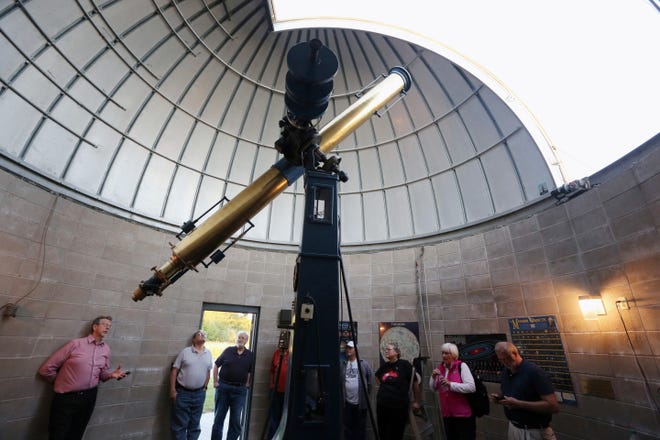
Judy Smithson-Hilkins of the Southeast Iowa Astronomy Club organized public speaking events by Green in August 2017 when he came back to Burlington to celebrate the 30th anniversary of the Witte Observatory’s 12-inch Alvan Clark and Sons refracting telescope.
During his visit, Green spoke with students at Aldo Leopold and Edward Stone middle schools about his work in astronomy, and he hosted a public presentation about the search for alien life.
He talked about the search for alien life at both Edward Stone presentations, but said that doesn’t mean friendly, sentient aliens are going to start falling from the sky.
“We are looking for life that metabolizes, reproduces and evolves. That’s our definition of life. And indeed, that can be very small. It could be microbial. In the solar system, there’s only a couple of places where complex life even has a chance to survive, other than the earth. One of the first places we’re looking for life is Mars,” Green said.
“Three-and-a-half billion years ago, Mars looked like the Earth. It had an enormous amount of water, it had a fabulous atmosphere, and it was the same time life started here on Earth,” he said.
More:‘It’s an employees’ market’: Burlington employers get creative to attract, retain staff
Throughout his 12 years as director of planetary sciences, Green said some of his proudest accomplishments included launching the Curiosity Rover and landing it on Mars in 2012, flying by Pluto and putting a spacecraft into orbit around the largest-known asteroid.
With the Mars Curiosity landing, which employed a risky and complicated maneuver involving, for the first time, a “sky crane,” he helped ensure that the world would celebrate the successful touchdown.
“I came to realize how important it was to tell the public what we were doing, to bring them along for the ride,” he said. “That really started with the landing of Curiosity.”
More:NASA and Tide are working on a long-standing space problem: cleaning astronauts’ laundry
Under Green’s leadership, NASA also successfully saw Juno investigate Jupiter, MESSENGER study Mercury, Dawn orbit both Vesta and Ceres, New Horizons fly by Pluto, and much more.
He helped develop a new way to engage the public in 2016 when he was invited to host a NASA podcast.
The show “Gravity Assist” is like eavesdropping on two scientists talking about the latest astronomical discoveries over lunch.
He named it “Gravity Assist” after the boost in speed that a spacecraft gets when it flies by a planetary body.
";}s:3:"wfw";a:1:{s:10:"commentrss";s:101:"https://genesisblocknews.com/space/burlington-native-nasa-chief-space-officer-jim-green-retires/feed/";}s:5:"slash";a:1:{s:8:"comments";s:1:"0";}s:7:"summary";s:647:"Jim Green, a Burlington native and Burlington High School graduate, is retiring this year as NASA’s Chief Science Officer. NASA released a statement in September announcing Green’s early 2022 retirement. A Jan. 2 New York Times piece notes Green said that we can transform Mars and maybe Venus, and that for decades, Green has shaped much ... Read more";s:12:"atom_content";s:8895:"
Jim Green, a Burlington native and Burlington High School graduate, is retiring this year as NASA’s Chief Science Officer.
NASA released a statement in September announcing Green’s early 2022 retirement.
A Jan. 2 New York Times piece notes Green said that we can transform Mars and maybe Venus, and that for decades, Green has shaped much of the space agency’s scientific inquiry.
Green’s star rose steadily since 1980 when, with a Ph.D. in space physics from the University of Iowa, he started at National Aeronautics and Space Administration.
His positions at the governmental space agency include head of the National Space Science Data Center, chief of the Space Science Data Operations Office, chief of the Science Proposal Support Office, and most recently, the director of NASA’s planetary sciences division.
From starting up NASA’s first internet to conducting groundbreaking research to hosting NASA’s popular podcast “Gravity Assist,” Green’s contributions to the agency are countless and varied.
“I feel tremendously proud about the activities I’ve done at NASA,” Green said in the release. “In many ways, NASA is not a job. It’s a way of life. We’re always looking for ways to do the impossible. The fact that we continue to succeed and do those things is a tremendous excitement for everyone, and really is important not just for NASA, but for the nation.”
Green, who has a keen interest in extraterrestrial life, approved plans for the Perseverance rover, which landed on Mars in February 2021.
“Where there is water, there is life,” he told CNN before the 2020 Mars Rover was set to launch and once landed, drill down to collect several dozen samples from deep in Mars’ surface, a move he felt “could rock astrobiology.”
More:After decades of planning, NASA’s $10 billion space telescope has ‘taken its final form’
After drilling miles into the Earth, researchers found more life in the Earth’s crust than on its surface, he said.
Currently, scientists are working to fix a clog caused by pebbles in a sixth surface collection by Perseverance, which has spotted a purple coating on Mars rocks, and now is exploring a crater on the dusty planet that was once a river delta.
Judy Smithson-Hilkins of the Southeast Iowa Astronomy Club organized public speaking events by Green in August 2017 when he came back to Burlington to celebrate the 30th anniversary of the Witte Observatory’s 12-inch Alvan Clark and Sons refracting telescope.
During his visit, Green spoke with students at Aldo Leopold and Edward Stone middle schools about his work in astronomy, and he hosted a public presentation about the search for alien life.
He talked about the search for alien life at both Edward Stone presentations, but said that doesn’t mean friendly, sentient aliens are going to start falling from the sky.
“We are looking for life that metabolizes, reproduces and evolves. That’s our definition of life. And indeed, that can be very small. It could be microbial. In the solar system, there’s only a couple of places where complex life even has a chance to survive, other than the earth. One of the first places we’re looking for life is Mars,” Green said.
“Three-and-a-half billion years ago, Mars looked like the Earth. It had an enormous amount of water, it had a fabulous atmosphere, and it was the same time life started here on Earth,” he said.
More:‘It’s an employees’ market’: Burlington employers get creative to attract, retain staff
Throughout his 12 years as director of planetary sciences, Green said some of his proudest accomplishments included launching the Curiosity Rover and landing it on Mars in 2012, flying by Pluto and putting a spacecraft into orbit around the largest-known asteroid.
With the Mars Curiosity landing, which employed a risky and complicated maneuver involving, for the first time, a “sky crane,” he helped ensure that the world would celebrate the successful touchdown.
“I came to realize how important it was to tell the public what we were doing, to bring them along for the ride,” he said. “That really started with the landing of Curiosity.”
More:NASA and Tide are working on a long-standing space problem: cleaning astronauts’ laundry
Under Green’s leadership, NASA also successfully saw Juno investigate Jupiter, MESSENGER study Mercury, Dawn orbit both Vesta and Ceres, New Horizons fly by Pluto, and much more.
He helped develop a new way to engage the public in 2016 when he was invited to host a NASA podcast.
The show “Gravity Assist” is like eavesdropping on two scientists talking about the latest astronomical discoveries over lunch.
He named it “Gravity Assist” after the boost in speed that a spacecraft gets when it flies by a planetary body.
";s:14:"date_timestamp";i:1642608518;}i:4;a:14:{s:5:"title";s:153:"Thematic ETFs investing in everything from meme stocks to space travel have boomed — but they’re expensive and don’t beat the market, JPMorgan says";s:4:"link";s:178:"https://genesisblocknews.com/space/thematic-etfs-investing-in-everything-from-meme-stocks-to-space-travel-have-boomed-but-theyre-expensive-and-dont-beat-the-market-jpmorgan-says/";s:8:"comments";s:186:"https://genesisblocknews.com/space/thematic-etfs-investing-in-everything-from-meme-stocks-to-space-travel-have-boomed-but-theyre-expensive-and-dont-beat-the-market-jpmorgan-says/#respond";s:2:"dc";a:1:{s:7:"creator";s:10:"Susan Hall";}s:7:"pubdate";s:31:"Wed, 19 Jan 2022 14:39:38 +0000";s:8:"category";s:91:"SpaceBeatboomeddontETFsexpensiveinvestingJPMorganMarketmêmespaceStocksThematicTheyreTravel";s:4:"guid";s:177:"http://genesisblocknews.com/space/thematic-etfs-investing-in-everything-from-meme-stocks-to-space-travel-have-boomed-but-theyre-expensive-and-dont-beat-the-market-jpmorgan-says/";s:11:"description";s:967:"Catherine Wood, chief executive officer and chief investment officer, Ark Invest. Patrick T. Fallon/Getty Images The allure of investing in next-generation themes like robots and space travel doesn’t lead to outperformance for investors, according to JPMorgan. The bank analyzed the performance of various thematic ETFs and found they’re expensive and often pay high prices for ... Read more";s:7:"content";a:1:{s:7:"encoded";s:4055:"
The allure of investing in next-generation themes like robots and space travel doesn’t lead to outperformance for investors, according to JPMorgan.
The bank analyzed the performance of various thematic ETFs and found they’re expensive and often pay high prices for “hot” stocks.
“High expenses and negative long-term alpha suggest the universe of thematic funds does not belong in one’s strategic asset allocation,” JPMorgan said.
Sign up here for our daily newsletter, 10 Things Before the Opening Bell.
Thematic investing has boomed in recent years, with assets invested in disruptive themes tripling over the past two years.
The success has benefited thematic investment managers like ARK Invest, which was an early buyer of Tesla and saw its assets under management skyrocket since its inception in 2014.
But the allure of investing in thematic ETFs that target various trends like robotics, space exploration, and renewable energy doesn’t benefit the end investor in the long-term due to high fees and underperformance relative to the broader stock market, according to a Tuesday note from JPMorgan.
The bank analyzed a broad set of 1,000 thematic funds over the past 16 years and found that they underperformed global equities by 1.6%. Much of the underperformance is due to high investment fees of more than 1%, and buying “hot” stocks at high prices.
“Our guess is that thematic funds get launched and attract a lot of inflows when certain themes become ‘hot.’ This suggests that thematic funds pay high prices for the stocks they select as they buy companies in sectors that fit the hot theme and where the theme is fully priced in,” JPMorgan explained.
This dynamic has played out in popular thematic ETFs managed by Ark Invest, which saw a surge in inflows as trending stocks like Tesla boomed. But high valuations and few profits generated by its underlying holdings fell out of favor amid a period of rising interest rates, leading to a deflation in assets and performance.
Thematic investment strategies “are overall high beta, with a focus on future growth, but are also negative alpha, maybe as they pay high prices for ‘hot’ stocks and themes,” JPMorgan said. Additionally, thematic funds charge on average 55 basis points more in fees relative to a passive global equity portfolio.
“High expenses and negative long-term alpha suggest the universe of thematic funds does not belong in one’s strategic asset allocation,” JPMorgan said.
JPMorgan admits there’s nothing wrong with expressing a particular theme through your investments, and investors can improve their chances of outperforming the market via thematic funds by investing in low-cost thematic ETFs, particularly thematic ETFs that are attached to a passive index rather than actively managed.
“In principle, there is nothing wrong with investing in views of a changing future, as we advised in many of our strategic notes. But one needs to be ‘economical’ with how one does this, selecting funds that charge no more than 1%,” JPMorgan concluded.
";}s:3:"wfw";a:1:{s:10:"commentrss";s:183:"https://genesisblocknews.com/space/thematic-etfs-investing-in-everything-from-meme-stocks-to-space-travel-have-boomed-but-theyre-expensive-and-dont-beat-the-market-jpmorgan-says/feed/";}s:5:"slash";a:1:{s:8:"comments";s:1:"0";}s:7:"summary";s:967:"Catherine Wood, chief executive officer and chief investment officer, Ark Invest. Patrick T. Fallon/Getty Images The allure of investing in next-generation themes like robots and space travel doesn’t lead to outperformance for investors, according to JPMorgan. The bank analyzed the performance of various thematic ETFs and found they’re expensive and often pay high prices for ... Read more";s:12:"atom_content";s:4055:"
The allure of investing in next-generation themes like robots and space travel doesn’t lead to outperformance for investors, according to JPMorgan.
The bank analyzed the performance of various thematic ETFs and found they’re expensive and often pay high prices for “hot” stocks.
“High expenses and negative long-term alpha suggest the universe of thematic funds does not belong in one’s strategic asset allocation,” JPMorgan said.
Sign up here for our daily newsletter, 10 Things Before the Opening Bell.
Thematic investing has boomed in recent years, with assets invested in disruptive themes tripling over the past two years.
The success has benefited thematic investment managers like ARK Invest, which was an early buyer of Tesla and saw its assets under management skyrocket since its inception in 2014.
But the allure of investing in thematic ETFs that target various trends like robotics, space exploration, and renewable energy doesn’t benefit the end investor in the long-term due to high fees and underperformance relative to the broader stock market, according to a Tuesday note from JPMorgan.
The bank analyzed a broad set of 1,000 thematic funds over the past 16 years and found that they underperformed global equities by 1.6%. Much of the underperformance is due to high investment fees of more than 1%, and buying “hot” stocks at high prices.
“Our guess is that thematic funds get launched and attract a lot of inflows when certain themes become ‘hot.’ This suggests that thematic funds pay high prices for the stocks they select as they buy companies in sectors that fit the hot theme and where the theme is fully priced in,” JPMorgan explained.
This dynamic has played out in popular thematic ETFs managed by Ark Invest, which saw a surge in inflows as trending stocks like Tesla boomed. But high valuations and few profits generated by its underlying holdings fell out of favor amid a period of rising interest rates, leading to a deflation in assets and performance.
Thematic investment strategies “are overall high beta, with a focus on future growth, but are also negative alpha, maybe as they pay high prices for ‘hot’ stocks and themes,” JPMorgan said. Additionally, thematic funds charge on average 55 basis points more in fees relative to a passive global equity portfolio.
“High expenses and negative long-term alpha suggest the universe of thematic funds does not belong in one’s strategic asset allocation,” JPMorgan said.
JPMorgan admits there’s nothing wrong with expressing a particular theme through your investments, and investors can improve their chances of outperforming the market via thematic funds by investing in low-cost thematic ETFs, particularly thematic ETFs that are attached to a passive index rather than actively managed.
“In principle, there is nothing wrong with investing in views of a changing future, as we advised in many of our strategic notes. But one needs to be ‘economical’ with how one does this, selecting funds that charge no more than 1%,” JPMorgan concluded.
";s:14:"date_timestamp";i:1642603178;}i:5;a:14:{s:5:"title";s:42:"SpaceX continues rapid-fire launch cadence";s:4:"link";s:78:"https://genesisblocknews.com/space/spacex-continues-rapid-fire-launch-cadence/";s:8:"comments";s:86:"https://genesisblocknews.com/space/spacex-continues-rapid-fire-launch-cadence/#respond";s:2:"dc";a:1:{s:7:"creator";s:10:"Susan Hall";}s:7:"pubdate";s:31:"Wed, 19 Jan 2022 13:08:47 +0000";s:8:"category";s:42:"SpacecadencecontinuesLaunchrapidfireSpacex";s:4:"guid";s:77:"http://genesisblocknews.com/space/spacex-continues-rapid-fire-launch-cadence/";s:11:"description";s:584:"Keeping up a rapid-fire launch pace, SpaceX fired off its third Falcon 9 of the year Tuesday, boosting another 49 Starlink internet satellites into orbit as the company continues building out a globe-spanning network of commercial broadband relay stations. The Falcon 9, using a first stage making its 10th flight, thundered to life and climbed ... Read more";s:7:"content";a:1:{s:7:"encoded";s:4287:"
Keeping up a rapid-fire launch pace, SpaceX fired off its third Falcon 9 of the year Tuesday, boosting another 49 Starlink internet satellites into orbit as the company continues building out a globe-spanning network of commercial broadband relay stations.
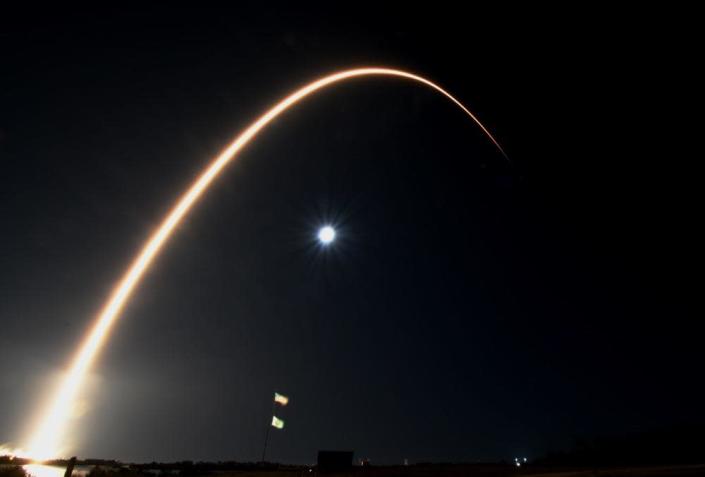
The Falcon 9, using a first stage making its 10th flight, thundered to life and climbed away from historic pad 39A at the Kennedy Space Center at 9:02 p.m. ET, arcing over a full moon as it headed out on a southeasterly trajectory tilted 53 degrees to the equator.
A time exposure captures the launch of a SpaceX Falcon 9 rocket over a full moon Tuesday as it climbed away from historic pad 39A at the Kennedy Space Center. It was SpaceX’s 121st Florida launch, but only the sixth taking off on a southeasterly trajectory. / Credit: William Harwood/CBS News
After boosting the rocket out of the lower atmosphere, the first stage fell away and flew itself back to landing on an off-shore droneship. It was SpaceX’s 103rd successful recovery and its 79th at sea.
The second stage slipped into its planned orbit a few seconds later and all 49 Starlinks were released to fly on their own a few minutes after that.
The exhaust plume of the Falcon 9’s second stage engine expands in the low-pressure environment of the extreme upper atmosphere, creating a ghostly cloud. The rocket’s first stage can be seen at left, along with the two halves of the rocket’s discarded nose cone fairing. / Credit: SpaceX webcast
The launching was the third so far this year for SpaceX, following another Starlink flight January 6 and a “rideshare” mission January 13 that put 105 small satellites in orbit.
Going into Tuesday’s flight, SpaceX had launched 1,993 Starlinks, of which 1,741 were thought to be functional. The company has regulatory approval to launch more than 12,000 Starlinks to provide space-based commercial internet access to customers anywhere in the world.
Biden administration warns of imminent Ukraine invasion
U.S. airlines express concerns over 5G service rollout near airports
Senate Democrats press ahead with voting rights legislation despite GOP opposition
";}s:3:"wfw";a:1:{s:10:"commentrss";s:83:"https://genesisblocknews.com/space/spacex-continues-rapid-fire-launch-cadence/feed/";}s:5:"slash";a:1:{s:8:"comments";s:1:"0";}s:7:"summary";s:584:"Keeping up a rapid-fire launch pace, SpaceX fired off its third Falcon 9 of the year Tuesday, boosting another 49 Starlink internet satellites into orbit as the company continues building out a globe-spanning network of commercial broadband relay stations. The Falcon 9, using a first stage making its 10th flight, thundered to life and climbed ... Read more";s:12:"atom_content";s:4287:"
Keeping up a rapid-fire launch pace, SpaceX fired off its third Falcon 9 of the year Tuesday, boosting another 49 Starlink internet satellites into orbit as the company continues building out a globe-spanning network of commercial broadband relay stations.
The Falcon 9, using a first stage making its 10th flight, thundered to life and climbed away from historic pad 39A at the Kennedy Space Center at 9:02 p.m. ET, arcing over a full moon as it headed out on a southeasterly trajectory tilted 53 degrees to the equator.
A time exposure captures the launch of a SpaceX Falcon 9 rocket over a full moon Tuesday as it climbed away from historic pad 39A at the Kennedy Space Center. It was SpaceX’s 121st Florida launch, but only the sixth taking off on a southeasterly trajectory. / Credit: William Harwood/CBS News
After boosting the rocket out of the lower atmosphere, the first stage fell away and flew itself back to landing on an off-shore droneship. It was SpaceX’s 103rd successful recovery and its 79th at sea.
The second stage slipped into its planned orbit a few seconds later and all 49 Starlinks were released to fly on their own a few minutes after that.
The exhaust plume of the Falcon 9’s second stage engine expands in the low-pressure environment of the extreme upper atmosphere, creating a ghostly cloud. The rocket’s first stage can be seen at left, along with the two halves of the rocket’s discarded nose cone fairing. / Credit: SpaceX webcast
The launching was the third so far this year for SpaceX, following another Starlink flight January 6 and a “rideshare” mission January 13 that put 105 small satellites in orbit.
Going into Tuesday’s flight, SpaceX had launched 1,993 Starlinks, of which 1,741 were thought to be functional. The company has regulatory approval to launch more than 12,000 Starlinks to provide space-based commercial internet access to customers anywhere in the world.
Biden administration warns of imminent Ukraine invasion
U.S. airlines express concerns over 5G service rollout near airports
Senate Democrats press ahead with voting rights legislation despite GOP opposition
";s:14:"date_timestamp";i:1642597727;}i:6;a:14:{s:5:"title";s:72:"Richard Branson’s Virgin Orbit rocket test launch fails | Virgin Group";s:4:"link";s:103:"https://genesisblocknews.com/space/richard-bransons-virgin-orbit-rocket-test-launch-fails-virgin-group/";s:8:"comments";s:111:"https://genesisblocknews.com/space/richard-bransons-virgin-orbit-rocket-test-launch-fails-virgin-group/#respond";s:2:"dc";a:1:{s:7:"creator";s:10:"Susan Hall";}s:7:"pubdate";s:31:"Wed, 19 Jan 2022 11:39:50 +0000";s:8:"category";s:57:"SpaceBransonsfailsGroupLaunchOrbitRichardrockettestVirgin";s:4:"guid";s:102:"http://genesisblocknews.com/space/richard-bransons-virgin-orbit-rocket-test-launch-fails-virgin-group/";s:11:"description";s:645:"Richard Branson’s Virgin Orbit has failed in its first test launch of a new rocket carried by a Boeing 747 and released over the Pacific Ocean off the coast of southern California. The inaugural launch had appeared to be going well until moments after the rocket was dropped from beneath the left wing of the ... Read more";s:7:"content";a:1:{s:7:"encoded";s:10944:"
Richard Branson’s Virgin Orbit has failed in its first test launch of a new rocket carried by a Boeing 747 and released over the Pacific Ocean off the coast of southern California.
The inaugural launch had appeared to be going well until moments after the rocket was dropped from beneath the left wing of the jumbo jet dubbed “Cosmic Girl”.
The launch failure is the latest setback for Branson, who recently announced he was selling $500m (£405m) worth of shares in his space travel business Virgin Galactic – a sister company of Orbit – to help prop up his ailing aviation and leisure businesses.
In its official Twitter commentary on the launch, Virgin Orbit said: “We’ve confirmed a clean release from the aircraft. However, the mission terminated shortly into the flight. Cosmic Girl and our flight crew are safe and returning to base.”
We’ve confirmed a clean release from the aircraft. However, the mission terminated shortly into the flight. Cosmic Girl and our flight crew are safe and returning to base.
There was no immediate explanation for what went wrong with the rocket, which carried a test satellite.
Will Pomerantz, Virgin Orbit’s vice-president for special projects, had said during a pre-flight briefing on Saturday that about half of first rocket launches failed.
“History is not terribly kind, necessarily, to maiden flights,” he said.
The jumbo jet took off from Mojave air and space port in the desert north of Los Angeles and flew out just beyond the Channel Islands, where the drop occurred.
The rocket was supposed to fall for a few seconds before the first of its two stages ignited and propelled it down the coast toward the south pole for insertion of its demonstration payload into a low Earth orbit.
The 21 metre (70ft) LauncherOne rocket has been in development for five years.
The effect of the setback on the company was not immediately clear. It has six more rockets under construction.
CEO Dan Hart on today’s mission: “Our team performed their pre-launch & flight operations with incredible skill today. Test flights are instrumented to yield data and we now have a treasure trove of that… we took a big step forward today.” Read more ↓ https://t.co/XxZV72aPDT
A successful launch by Virgin Orbit would have marked a significant step in getting back on track after the coronavirus pandemic sent most employees home earlier this year while work spaces, procedures and mission control were adjusted.
Virgin Orbit is targeting the market for launching satellites ranging in size from toasters to household refrigerators.
Virgin Orbit chief executive Dan Hart said the time was right for the small satellite launch market.
Technological advancements had enabled satellites much smaller than traditional payloads to do “real work” in space, typically from low Earth orbit, and for markets ranging from commercial to national security, he said on Saturday.
While other companies were developing rockets for the small satellite market and builders of big rockets such as SpaceX could carry them into orbit in a ride-share arrangement with large satellites, Virgin Orbit’s air launch system based on the aviation industry’s 747 was intended to put a satellite up when and where a customer needed it, Hart said.
“We can fly to space from any place that can host a 747, which is almost any place.”
Virgin Orbit says it has dozens of missions planned for customers, including the US Space Force and the Royal Air Force, and it is working on plans for launches from the UK and Japan.
The LauncherOne rocket approaching the Boeing 747-400 aircraft from which it was launched. Photograph: Virgin Orbit/PA
Virgin Orbit, based in Long Beach, California, began as a sister company of Virgin Galactic but has since separated.
The freeze in global travel is affecting a host of Virgin Group companies, including Virgin Atlantic, as well as its holidays, cruises and hotels businesses. The Virgin Australia airline has collapsed into administration and Virgin Atlantic is in severe financial difficulty. The carrier has announced plans to pull out of Gatwick airport and cut a third of jobs. The airline, in which Branson still holds a majority 51% stake, has been seeking emergency investment but is also seeking some form of state bailout to tide it over while planes remain grounded.
The 25m Virgin Galactic shares put up for sale account for just over a fifth of the billionaire’s stake in the space tourism business, which is preparing to begin flights carrying passengers into the lower reaches of space from southern New Mexico.
";}s:3:"wfw";a:1:{s:10:"commentrss";s:108:"https://genesisblocknews.com/space/richard-bransons-virgin-orbit-rocket-test-launch-fails-virgin-group/feed/";}s:5:"slash";a:1:{s:8:"comments";s:1:"0";}s:7:"summary";s:645:"Richard Branson’s Virgin Orbit has failed in its first test launch of a new rocket carried by a Boeing 747 and released over the Pacific Ocean off the coast of southern California. The inaugural launch had appeared to be going well until moments after the rocket was dropped from beneath the left wing of the ... Read more";s:12:"atom_content";s:10944:"
Richard Branson’s Virgin Orbit has failed in its first test launch of a new rocket carried by a Boeing 747 and released over the Pacific Ocean off the coast of southern California.
The inaugural launch had appeared to be going well until moments after the rocket was dropped from beneath the left wing of the jumbo jet dubbed “Cosmic Girl”.
The launch failure is the latest setback for Branson, who recently announced he was selling $500m (£405m) worth of shares in his space travel business Virgin Galactic – a sister company of Orbit – to help prop up his ailing aviation and leisure businesses.
In its official Twitter commentary on the launch, Virgin Orbit said: “We’ve confirmed a clean release from the aircraft. However, the mission terminated shortly into the flight. Cosmic Girl and our flight crew are safe and returning to base.”
We’ve confirmed a clean release from the aircraft. However, the mission terminated shortly into the flight. Cosmic Girl and our flight crew are safe and returning to base.
There was no immediate explanation for what went wrong with the rocket, which carried a test satellite.
Will Pomerantz, Virgin Orbit’s vice-president for special projects, had said during a pre-flight briefing on Saturday that about half of first rocket launches failed.
“History is not terribly kind, necessarily, to maiden flights,” he said.
The jumbo jet took off from Mojave air and space port in the desert north of Los Angeles and flew out just beyond the Channel Islands, where the drop occurred.
The rocket was supposed to fall for a few seconds before the first of its two stages ignited and propelled it down the coast toward the south pole for insertion of its demonstration payload into a low Earth orbit.
The 21 metre (70ft) LauncherOne rocket has been in development for five years.
The effect of the setback on the company was not immediately clear. It has six more rockets under construction.
CEO Dan Hart on today’s mission: “Our team performed their pre-launch & flight operations with incredible skill today. Test flights are instrumented to yield data and we now have a treasure trove of that… we took a big step forward today.” Read more ↓ https://t.co/XxZV72aPDT
A successful launch by Virgin Orbit would have marked a significant step in getting back on track after the coronavirus pandemic sent most employees home earlier this year while work spaces, procedures and mission control were adjusted.
Virgin Orbit is targeting the market for launching satellites ranging in size from toasters to household refrigerators.
Virgin Orbit chief executive Dan Hart said the time was right for the small satellite launch market.
Technological advancements had enabled satellites much smaller than traditional payloads to do “real work” in space, typically from low Earth orbit, and for markets ranging from commercial to national security, he said on Saturday.
While other companies were developing rockets for the small satellite market and builders of big rockets such as SpaceX could carry them into orbit in a ride-share arrangement with large satellites, Virgin Orbit’s air launch system based on the aviation industry’s 747 was intended to put a satellite up when and where a customer needed it, Hart said.
“We can fly to space from any place that can host a 747, which is almost any place.”
Virgin Orbit says it has dozens of missions planned for customers, including the US Space Force and the Royal Air Force, and it is working on plans for launches from the UK and Japan.
The LauncherOne rocket approaching the Boeing 747-400 aircraft from which it was launched. Photograph: Virgin Orbit/PA
Virgin Orbit, based in Long Beach, California, began as a sister company of Virgin Galactic but has since separated.
The freeze in global travel is affecting a host of Virgin Group companies, including Virgin Atlantic, as well as its holidays, cruises and hotels businesses. The Virgin Australia airline has collapsed into administration and Virgin Atlantic is in severe financial difficulty. The carrier has announced plans to pull out of Gatwick airport and cut a third of jobs. The airline, in which Branson still holds a majority 51% stake, has been seeking emergency investment but is also seeking some form of state bailout to tide it over while planes remain grounded.
The 25m Virgin Galactic shares put up for sale account for just over a fifth of the billionaire’s stake in the space tourism business, which is preparing to begin flights carrying passengers into the lower reaches of space from southern New Mexico.
";s:14:"date_timestamp";i:1642592390;}i:7;a:14:{s:5:"title";s:58:"To protect biodiversity, scientists call for major changes";s:4:"link";s:93:"https://genesisblocknews.com/space/to-protect-biodiversity-scientists-call-for-major-changes/";s:8:"comments";s:101:"https://genesisblocknews.com/space/to-protect-biodiversity-scientists-call-for-major-changes/#respond";s:2:"dc";a:1:{s:7:"creator";s:10:"Susan Hall";}s:7:"pubdate";s:31:"Wed, 19 Jan 2022 10:10:35 +0000";s:8:"category";s:43:"SpacebiodiversityCallMajorProtectscientists";s:4:"guid";s:92:"http://genesisblocknews.com/space/to-protect-biodiversity-scientists-call-for-major-changes/";s:11:"description";s:633:"A black-tailed godwit, an endangered species, and many other waders in the national nature reserve of Lilleau des Niges, in New Aquitaine, on January 14, 2022. MATHIEU PUJOL FOR “THE WORLD” Twenty-one targets, ten milestones, four major objectives… The project for a new global framework on biodiversity is, to say the least, dense. To help ... Read more";s:7:"content";a:1:{s:7:"encoded";s:4059:"
A black-tailed godwit, an endangered species, and many other waders in the national nature reserve of Lilleau des Niges, in New Aquitaine, on January 14, 2022. MATHIEU PUJOL FOR “THE WORLD”
Twenty-one targets, ten milestones, four major objectives… The project for a new global framework on biodiversity is, to say the least, dense. To help decision-makers prioritize their actions, some fifty experts from 23 countries are publishing, under the leadership of the bioDiscovery research program and the Group on Earth Observation – Biodiversity Observation Network, a report of evaluation of the text presented in July 2021. “We wanted to show negotiators what the most recent scientific literature says about how to halt the loss of biodiversity,” explains Cornelia Krug, director of bioDiscovery and researcher at the University of Zurich, Switzerland.
The publication of this document, Wednesday, January 19, comes in a complicated context for international negotiations. The 15e conference of the parties to the Convention on Biological Diversity, which officially opened in October in China and was to be held in the spring, has again been postponed due to the health situation, without any new date having been announced. announced. This meeting must lead to the conclusion of a global framework aimed at putting an end, by 2030, to the unprecedented collapse of biodiversity. An important meeting, which should allow negotiators to meet face-to-face for the first time in two years, is however scheduled for mid-March in Switzerland.
Read also:Article reserved for our subscribers Biodiversity: with its “Kunming Declaration”, China is launching the negotiation of a new global framework.
The opportunity for the authors of the report to convey a strong message: “classic” conservation efforts, such as networks of protected areas, species protection plans or restoration measures, will absolutely not be sufficient to halt the loss of animal and plant diversity. However, since the start of the negotiations, attention has largely focused on the objective of protecting 30% of land and seas by 2030, carried by an international coalition chaired by France and Costa Rica.
“Radical changes needed”
“There is very good evidence that we will again fail to achieve ambitious goals if too much emphasis is placed on protected areas at the expense of other urgent actions to address threats to biodiversity, explains Paul Leadley, author of several reports of the intergovernmental scientific and political platform on biodiversity and ecosystem services (Ipbes) and professor at the University of Paris-Saclay. Governments are clearly grappling with the breadth and depth of sweeping changenecessary, but these changes will greatly benefit populations in the long term. »
You have 32.89% of this article left to read. The following is for subscribers only.
";}s:3:"wfw";a:1:{s:10:"commentrss";s:98:"https://genesisblocknews.com/space/to-protect-biodiversity-scientists-call-for-major-changes/feed/";}s:5:"slash";a:1:{s:8:"comments";s:1:"0";}s:7:"summary";s:633:"A black-tailed godwit, an endangered species, and many other waders in the national nature reserve of Lilleau des Niges, in New Aquitaine, on January 14, 2022. MATHIEU PUJOL FOR “THE WORLD” Twenty-one targets, ten milestones, four major objectives… The project for a new global framework on biodiversity is, to say the least, dense. To help ... Read more";s:12:"atom_content";s:4059:"
A black-tailed godwit, an endangered species, and many other waders in the national nature reserve of Lilleau des Niges, in New Aquitaine, on January 14, 2022. MATHIEU PUJOL FOR “THE WORLD”
Twenty-one targets, ten milestones, four major objectives… The project for a new global framework on biodiversity is, to say the least, dense. To help decision-makers prioritize their actions, some fifty experts from 23 countries are publishing, under the leadership of the bioDiscovery research program and the Group on Earth Observation – Biodiversity Observation Network, a report of evaluation of the text presented in July 2021. “We wanted to show negotiators what the most recent scientific literature says about how to halt the loss of biodiversity,” explains Cornelia Krug, director of bioDiscovery and researcher at the University of Zurich, Switzerland.
The publication of this document, Wednesday, January 19, comes in a complicated context for international negotiations. The 15e conference of the parties to the Convention on Biological Diversity, which officially opened in October in China and was to be held in the spring, has again been postponed due to the health situation, without any new date having been announced. announced. This meeting must lead to the conclusion of a global framework aimed at putting an end, by 2030, to the unprecedented collapse of biodiversity. An important meeting, which should allow negotiators to meet face-to-face for the first time in two years, is however scheduled for mid-March in Switzerland.
Read also:Article reserved for our subscribers Biodiversity: with its “Kunming Declaration”, China is launching the negotiation of a new global framework.
The opportunity for the authors of the report to convey a strong message: “classic” conservation efforts, such as networks of protected areas, species protection plans or restoration measures, will absolutely not be sufficient to halt the loss of animal and plant diversity. However, since the start of the negotiations, attention has largely focused on the objective of protecting 30% of land and seas by 2030, carried by an international coalition chaired by France and Costa Rica.
“Radical changes needed”
“There is very good evidence that we will again fail to achieve ambitious goals if too much emphasis is placed on protected areas at the expense of other urgent actions to address threats to biodiversity, explains Paul Leadley, author of several reports of the intergovernmental scientific and political platform on biodiversity and ecosystem services (Ipbes) and professor at the University of Paris-Saclay. Governments are clearly grappling with the breadth and depth of sweeping changenecessary, but these changes will greatly benefit populations in the long term. »
You have 32.89% of this article left to read. The following is for subscribers only.
";s:14:"date_timestamp";i:1642587035;}i:8;a:14:{s:5:"title";s:68:"Earth Matters – NASA To Launch Four Earth Science Missions in 2022";s:4:"link";s:100:"https://genesisblocknews.com/space/earth-matters-nasa-to-launch-four-earth-science-missions-in-2022/";s:8:"comments";s:108:"https://genesisblocknews.com/space/earth-matters-nasa-to-launch-four-earth-science-missions-in-2022/#respond";s:2:"dc";a:1:{s:7:"creator";s:10:"Susan Hall";}s:7:"pubdate";s:31:"Wed, 19 Jan 2022 07:12:48 +0000";s:8:"category";s:42:"SpaceEarthLaunchmattersmissionsNASAscience";s:4:"guid";s:99:"http://genesisblocknews.com/space/earth-matters-nasa-to-launch-four-earth-science-missions-in-2022/";s:11:"description";s:701:"NASA will launch four Earth science missions in 2022 to provide scientists with more information about fundamental climate systems and processes including extreme storms, surface water and oceans, and atmospheric dust. Scientists will discuss the upcoming missions at the American Geophysical Union’s (AGU) 2021 Fall Meeting, hosted in New Orleans between Dec. 13 and 17. NASA ... Read more";s:7:"content";a:1:{s:7:"encoded";s:12163:"
NASA will launch four Earth science missions in 2022 to provide scientists with more information about fundamental climate systems and processes including extreme storms, surface water and oceans, and atmospheric dust. Scientists will discuss the upcoming missions at the American Geophysical Union’s (AGU) 2021 Fall Meeting, hosted in New Orleans between Dec. 13 and 17.
NASA has a unique view of our planet from space. NASA’s fleet of Earth-observing satellites provides high-quality data on Earth’s interconnected environment, from air quality to sea ice. These four missions will enhance the ability to monitor our changing planet:
TROPICS will use six small satellites to provide improved and rapid measurements of tropical cyclones.
EMIT will trace the origin and composition of mineral dust that can affect climate, ecosystems, air quality, and human health with an imaging spectrometer aboard the International Space Station.
NOAA’s JPSS-2 will help scientists predict extreme weather conditions including floods, wildfires, volcanoes and more.
SWOT will evaluate the world’s oceans and their role in climate change, as well as monitor lakes, rivers, and other surface waters.
Measuring Tropical Cyclones – Time-Resolved Observations of Precipitation structure and storm Intensity with a Constellation of Smallsats (TROPICS)
NASA’s TROPICS mission aims to improve observations of tropical cyclones. Six TROPICS satellites will work in concert to provide microwave observations of a storm’s precipitation, temperature, and humidity as quickly as every 50 minutes. Scientists expect the data will help them understand the factors driving tropical cyclone intensification and will contribute to weather forecasting models.
In June 2021, the first pathfinder, or proof of concept satellite of the constellation started collecting data, including from Hurricane Ida in August 2021. The TROPICS satellites will be deployed in pairs of two over three different launches, expected to be completed by July 31, 2022.
Each satellite is about the size of a loaf of bread and carries a miniaturized microwave radiometer instrument. Traveling in pairs in three different orbits, they will collectively observe Earth’s surface more frequently than current weather satellites making similar measurements, greatly increasing the data available for near real-time weather forecasts.
The TROPICS team is led by Principal Investigator Dr. William Blackwell at MIT’s Lincoln Laboratory in Lexington, Massachusetts, and includes researchers from NASA, the National Oceanic and Atmospheric Administration (NOAA), and several universities and commercial partners. NASA’s Launch Services Program, based at the agency’s Kennedy Space Center in Florida, will manage the launch service.
“The coolest part of this program is its impact on helping society,” Blackwell said. “These storms affect a lot of people. The higher frequency observations provided by TROPICS have the potential to support weather forecasting that may help people get to safety sooner.”
Studying Mineral Dust — Earth Surface Mineral Dust Source Investigation (EMIT)
Winds kick up dust from Earth’s arid regions and transport the mineral particles around the world. The dust can influence the radiative forcing — or the balance between the energy that comes toward Earth from the Sun, and the energy that Earth reflects back out into space — hence the temperature of the planet’s surface and atmosphere. Darker, iron-laden minerals tend to absorb energy, which leads to heating of the environment, while brighter, clay-containing particles scatter light in a way that may lead to cooling. In addition to affecting regional and global warming of the atmosphere, dust can affect air quality and the health of people worldwide, and when deposited in the ocean, can also trigger blooms of microscopic algae.
In June 2020, the “Godzilla” dust storm traveled from the Sahara desert across the Atlantic Ocean, as seen in this true-color satellite imagery from the Visible Infrared Imaging Radiometer Suite (VIIRS) aboard the NASA-NOAA Suomi NPP satellite and the NOAA-20 satellite. Image Credit: NASA / Scientific Visualization Studio
The goal of the Earth Surface Mineral Dust Source Investigation (EMIT) mission is to map where the dust originates and estimate its composition so that scientists can better understand how it affects the planet. Targeted to launch in 2022, EMIT has a prime mission of one year and will be installed on the International Space Station. EMIT will use an instrument called an imaging spectrometer that measures visible and infrared light reflecting from surfaces below. This data can reveal the distinct light-absorbing signatures of the minerals in the dust that helps to determine their composition.
“EMIT will close a gap in our knowledge about arid land regions of our planet and answer key questions about how mineral dust interacts with the Earth system,” said Dr. Robert Green, EMIT principal investigator at NASA’s Jet Propulsion Laboratory.
Observing Earth’s Storms — Joint Polar Satellite System (JPSS)
Forecasting extreme storms many days in advance requires capturing precise measurements of the temperature and moisture in our atmosphere, along with ocean surface temperatures. The NOAA/NASA Joint Polar Satellite System satellites provide this critical data, which is used by forecasters and first responders. The satellites also tell us about floods, wildfires, volcanoes, smog, dust storms, and sea ice.
“JPSS satellites are a vital component of the global backbone of numerical weather prediction,” said JPSS Program Science Adviser Dr. Satya Kalluri.
An illustration of the Joint Polar Satellite System (JPSS). JPSS is a collaborative program between the National Oceanic and Atmospheric Administration (NOAA) and NASA. JPSS-2 is NOAA’s next-generation operational Earth observation program that acquires and distributes global environmental data primarily from multiple polar-orbiting satellites. Image Credit: Orbital ATK/Northrop Grumman Innovation Systems
The JPSS satellites circle Earth from the North to the South Pole, taking data and images as they fly. As Earth rotates under these satellites, they observe every part of the planet at least twice a day.
The Suomi-NPP (National Polar orbiting-Partnership) and NOAA-20 satellites are currently in orbit. The JPSS-2 satellite is targeted to launch in 2022 from Vandenberg Space Force Base in California on a United Launch Alliance Atlas V rocket. Three more satellites will launch in the coming years, providing data well into the 2030s. NASA’s Launch Services Program, based at the agency’s Kennedy Space Center in Florida, will manage the launch service.
Surveying Earth’s Surface Water and Oceans – Surface Water and Ocean Topography (SWOT)
The Surface Water and Ocean Topography (SWOT) mission will help researchers determine how much water Earth’s oceans, lakes, and rivers contain. This will aid scientists in understanding the effects of climate change on freshwater bodies and the ocean’s ability to absorb excess heat and greenhouse gases like carbon dioxide.
NASA’s Launch Services Program, based at the agency’s Kennedy Space Center in Florida, will manage the launch service, which is targeted for November 2022. SWOT will launch on a SpaceX Falcon 9 rocket from Vandenberg Space Force Base in California.
SWOT will collect data across a 75-mile (120-kilometer) wide swath, with a gap in the center for an altimetry track. This animation shows the collection of data over the state of Florida, which is rich with rivers, lakes, and wetlands. Globally, measurements will be taken both over the ocean and over freshwater areas. Image Credit: NASA/JPL-Caltech
The SUV-size satellite will measure the height of water using its Ka-band Radar Interferometer, a new instrument that bounces radar pulses off the water’s surface and receives the return signals with two different antennas at the same time. This measurement technique allows scientists to precisely calculate the height of the water. The data will help with tasks like tracking regional shifts in sea level, monitoring changes in river flows and how much water lakes store, as well as determining how much freshwater is available to communities around the world.
“SWOT will address the ocean’s leading role in our changing weather and climate and the consequences on the availability of freshwater on land,” said Dr. Lee-Lueng Fu, SWOT project scientist at NASA’s Jet Propulsion Laboratory.
The mission is a collaboration between NASA and the French space agency Centre National d’Etudes Spatiales, with contributions from the Canadian Space Agency and the United Kingdom Space Agency.
This entry was posted
on Thursday, December 30th, 2021 at 12:05 pm
and is filed under In Case You Missed It, NASA News.
You can follow any responses to this entry through the RSS 2.0 feed.
You can skip to the end and leave a response. Pinging is currently not allowed.
";}s:3:"wfw";a:1:{s:10:"commentrss";s:105:"https://genesisblocknews.com/space/earth-matters-nasa-to-launch-four-earth-science-missions-in-2022/feed/";}s:5:"slash";a:1:{s:8:"comments";s:1:"0";}s:7:"summary";s:701:"NASA will launch four Earth science missions in 2022 to provide scientists with more information about fundamental climate systems and processes including extreme storms, surface water and oceans, and atmospheric dust. Scientists will discuss the upcoming missions at the American Geophysical Union’s (AGU) 2021 Fall Meeting, hosted in New Orleans between Dec. 13 and 17. NASA ... Read more";s:12:"atom_content";s:12163:"
NASA will launch four Earth science missions in 2022 to provide scientists with more information about fundamental climate systems and processes including extreme storms, surface water and oceans, and atmospheric dust. Scientists will discuss the upcoming missions at the American Geophysical Union’s (AGU) 2021 Fall Meeting, hosted in New Orleans between Dec. 13 and 17.
NASA has a unique view of our planet from space. NASA’s fleet of Earth-observing satellites provides high-quality data on Earth’s interconnected environment, from air quality to sea ice. These four missions will enhance the ability to monitor our changing planet:
TROPICS will use six small satellites to provide improved and rapid measurements of tropical cyclones.
EMIT will trace the origin and composition of mineral dust that can affect climate, ecosystems, air quality, and human health with an imaging spectrometer aboard the International Space Station.
NOAA’s JPSS-2 will help scientists predict extreme weather conditions including floods, wildfires, volcanoes and more.
SWOT will evaluate the world’s oceans and their role in climate change, as well as monitor lakes, rivers, and other surface waters.
Measuring Tropical Cyclones – Time-Resolved Observations of Precipitation structure and storm Intensity with a Constellation of Smallsats (TROPICS)
NASA’s TROPICS mission aims to improve observations of tropical cyclones. Six TROPICS satellites will work in concert to provide microwave observations of a storm’s precipitation, temperature, and humidity as quickly as every 50 minutes. Scientists expect the data will help them understand the factors driving tropical cyclone intensification and will contribute to weather forecasting models.
In June 2021, the first pathfinder, or proof of concept satellite of the constellation started collecting data, including from Hurricane Ida in August 2021. The TROPICS satellites will be deployed in pairs of two over three different launches, expected to be completed by July 31, 2022.
Each satellite is about the size of a loaf of bread and carries a miniaturized microwave radiometer instrument. Traveling in pairs in three different orbits, they will collectively observe Earth’s surface more frequently than current weather satellites making similar measurements, greatly increasing the data available for near real-time weather forecasts.
The TROPICS team is led by Principal Investigator Dr. William Blackwell at MIT’s Lincoln Laboratory in Lexington, Massachusetts, and includes researchers from NASA, the National Oceanic and Atmospheric Administration (NOAA), and several universities and commercial partners. NASA’s Launch Services Program, based at the agency’s Kennedy Space Center in Florida, will manage the launch service.
“The coolest part of this program is its impact on helping society,” Blackwell said. “These storms affect a lot of people. The higher frequency observations provided by TROPICS have the potential to support weather forecasting that may help people get to safety sooner.”
Studying Mineral Dust — Earth Surface Mineral Dust Source Investigation (EMIT)
Winds kick up dust from Earth’s arid regions and transport the mineral particles around the world. The dust can influence the radiative forcing — or the balance between the energy that comes toward Earth from the Sun, and the energy that Earth reflects back out into space — hence the temperature of the planet’s surface and atmosphere. Darker, iron-laden minerals tend to absorb energy, which leads to heating of the environment, while brighter, clay-containing particles scatter light in a way that may lead to cooling. In addition to affecting regional and global warming of the atmosphere, dust can affect air quality and the health of people worldwide, and when deposited in the ocean, can also trigger blooms of microscopic algae.
In June 2020, the “Godzilla” dust storm traveled from the Sahara desert across the Atlantic Ocean, as seen in this true-color satellite imagery from the Visible Infrared Imaging Radiometer Suite (VIIRS) aboard the NASA-NOAA Suomi NPP satellite and the NOAA-20 satellite. Image Credit: NASA / Scientific Visualization Studio
The goal of the Earth Surface Mineral Dust Source Investigation (EMIT) mission is to map where the dust originates and estimate its composition so that scientists can better understand how it affects the planet. Targeted to launch in 2022, EMIT has a prime mission of one year and will be installed on the International Space Station. EMIT will use an instrument called an imaging spectrometer that measures visible and infrared light reflecting from surfaces below. This data can reveal the distinct light-absorbing signatures of the minerals in the dust that helps to determine their composition.
“EMIT will close a gap in our knowledge about arid land regions of our planet and answer key questions about how mineral dust interacts with the Earth system,” said Dr. Robert Green, EMIT principal investigator at NASA’s Jet Propulsion Laboratory.
Observing Earth’s Storms — Joint Polar Satellite System (JPSS)
Forecasting extreme storms many days in advance requires capturing precise measurements of the temperature and moisture in our atmosphere, along with ocean surface temperatures. The NOAA/NASA Joint Polar Satellite System satellites provide this critical data, which is used by forecasters and first responders. The satellites also tell us about floods, wildfires, volcanoes, smog, dust storms, and sea ice.
“JPSS satellites are a vital component of the global backbone of numerical weather prediction,” said JPSS Program Science Adviser Dr. Satya Kalluri.
An illustration of the Joint Polar Satellite System (JPSS). JPSS is a collaborative program between the National Oceanic and Atmospheric Administration (NOAA) and NASA. JPSS-2 is NOAA’s next-generation operational Earth observation program that acquires and distributes global environmental data primarily from multiple polar-orbiting satellites. Image Credit: Orbital ATK/Northrop Grumman Innovation Systems
The JPSS satellites circle Earth from the North to the South Pole, taking data and images as they fly. As Earth rotates under these satellites, they observe every part of the planet at least twice a day.
The Suomi-NPP (National Polar orbiting-Partnership) and NOAA-20 satellites are currently in orbit. The JPSS-2 satellite is targeted to launch in 2022 from Vandenberg Space Force Base in California on a United Launch Alliance Atlas V rocket. Three more satellites will launch in the coming years, providing data well into the 2030s. NASA’s Launch Services Program, based at the agency’s Kennedy Space Center in Florida, will manage the launch service.
Surveying Earth’s Surface Water and Oceans – Surface Water and Ocean Topography (SWOT)
The Surface Water and Ocean Topography (SWOT) mission will help researchers determine how much water Earth’s oceans, lakes, and rivers contain. This will aid scientists in understanding the effects of climate change on freshwater bodies and the ocean’s ability to absorb excess heat and greenhouse gases like carbon dioxide.
NASA’s Launch Services Program, based at the agency’s Kennedy Space Center in Florida, will manage the launch service, which is targeted for November 2022. SWOT will launch on a SpaceX Falcon 9 rocket from Vandenberg Space Force Base in California.
SWOT will collect data across a 75-mile (120-kilometer) wide swath, with a gap in the center for an altimetry track. This animation shows the collection of data over the state of Florida, which is rich with rivers, lakes, and wetlands. Globally, measurements will be taken both over the ocean and over freshwater areas. Image Credit: NASA/JPL-Caltech
The SUV-size satellite will measure the height of water using its Ka-band Radar Interferometer, a new instrument that bounces radar pulses off the water’s surface and receives the return signals with two different antennas at the same time. This measurement technique allows scientists to precisely calculate the height of the water. The data will help with tasks like tracking regional shifts in sea level, monitoring changes in river flows and how much water lakes store, as well as determining how much freshwater is available to communities around the world.
“SWOT will address the ocean’s leading role in our changing weather and climate and the consequences on the availability of freshwater on land,” said Dr. Lee-Lueng Fu, SWOT project scientist at NASA’s Jet Propulsion Laboratory.
The mission is a collaboration between NASA and the French space agency Centre National d’Etudes Spatiales, with contributions from the Canadian Space Agency and the United Kingdom Space Agency.
This entry was posted
on Thursday, December 30th, 2021 at 12:05 pm
and is filed under In Case You Missed It, NASA News.
You can follow any responses to this entry through the RSS 2.0 feed.
You can skip to the end and leave a response. Pinging is currently not allowed.
";s:14:"date_timestamp";i:1642576368;}i:9;a:14:{s:5:"title";s:59:"2023 Ford Bronco Raptor interior revealed in new spy photos";s:4:"link";s:95:"https://genesisblocknews.com/space/2023-ford-bronco-raptor-interior-revealed-in-new-spy-photos/";s:8:"comments";s:103:"https://genesisblocknews.com/space/2023-ford-bronco-raptor-interior-revealed-in-new-spy-photos/#respond";s:2:"dc";a:1:{s:7:"creator";s:10:"Susan Hall";}s:7:"pubdate";s:31:"Wed, 19 Jan 2022 05:43:35 +0000";s:8:"category";s:46:"SpaceBroncoFordInteriorPhotosRaptorrevealedspy";s:4:"guid";s:94:"http://genesisblocknews.com/space/2023-ford-bronco-raptor-interior-revealed-in-new-spy-photos/";s:11:"description";s:603:"See Full Image Gallery >> A 2023 Ford Bronco Raptor prototype looking suspiciously similar to the one Ford teased late last year has been spotted in the wild with a partially uncovered interior, giving us our first look at what the Blue Oval has in store for the new apex Bronco’s cabin. While many details ... Read more";s:7:"content";a:1:{s:7:"encoded";s:4197:"
See Full Image Gallery >>
A 2023 Ford Bronco Raptor prototype looking suspiciously similar to the one Ford teased late last year has been spotted in the wild with a partially uncovered interior, giving us our first look at what the Blue Oval has in store for the new apex Bronco’s cabin.
While many details remain hidden, there are a couple of noteworthy differentiators here. The wheel logo has been covered up, but we’re betting there’s something specific to the Raptor underneath. The red accents on the vent knobs, GOAT mode selector, shift boot and wheel stitching are probably going to be Raptor signature elements, and we’ve seen similar approaches to the Bronco’s other variants. The center-console grab handle (covered here) will likely carry on this trend too.
The biggest stand-out feature here is the paddle shifters, which are conspicuously absent on the current Bronco crop (but available on the 2.0L Bronco Sport, curiously enough). Just behind these, we see a full digital instrument cluster. The dash-top switches all seem to be directly ported over from Broncos will all the bells and whistles, so there’s really nothing new to decipher from there.
As we’ve seen previously, this prototype has unique amber LED daytime running lights, the opened-up grille, and bold “FORD” lettering in the middle like its big F-150 cousin. Around the sides are far wider fender flares (expected to house factory 37s) and at the back, the taillights appear tinted and the third brake light is wider and contains the mandated rear running lights (mirroring those found up front).
Ford has already confirmed that the Bronco Raptor is due to go on sale this year, with rumors pointing to summer. While the state of the global supply chain appears to be improving for automotive production, we’re inclined to say it’ll get here when it gets here. Hopefully that will be in 2022.
Related Video
";}s:3:"wfw";a:1:{s:10:"commentrss";s:100:"https://genesisblocknews.com/space/2023-ford-bronco-raptor-interior-revealed-in-new-spy-photos/feed/";}s:5:"slash";a:1:{s:8:"comments";s:1:"0";}s:7:"summary";s:603:"See Full Image Gallery >> A 2023 Ford Bronco Raptor prototype looking suspiciously similar to the one Ford teased late last year has been spotted in the wild with a partially uncovered interior, giving us our first look at what the Blue Oval has in store for the new apex Bronco’s cabin. While many details ... Read more";s:12:"atom_content";s:4197:"
See Full Image Gallery >>
A 2023 Ford Bronco Raptor prototype looking suspiciously similar to the one Ford teased late last year has been spotted in the wild with a partially uncovered interior, giving us our first look at what the Blue Oval has in store for the new apex Bronco’s cabin.
While many details remain hidden, there are a couple of noteworthy differentiators here. The wheel logo has been covered up, but we’re betting there’s something specific to the Raptor underneath. The red accents on the vent knobs, GOAT mode selector, shift boot and wheel stitching are probably going to be Raptor signature elements, and we’ve seen similar approaches to the Bronco’s other variants. The center-console grab handle (covered here) will likely carry on this trend too.
The biggest stand-out feature here is the paddle shifters, which are conspicuously absent on the current Bronco crop (but available on the 2.0L Bronco Sport, curiously enough). Just behind these, we see a full digital instrument cluster. The dash-top switches all seem to be directly ported over from Broncos will all the bells and whistles, so there’s really nothing new to decipher from there.
As we’ve seen previously, this prototype has unique amber LED daytime running lights, the opened-up grille, and bold “FORD” lettering in the middle like its big F-150 cousin. Around the sides are far wider fender flares (expected to house factory 37s) and at the back, the taillights appear tinted and the third brake light is wider and contains the mandated rear running lights (mirroring those found up front).
Ford has already confirmed that the Bronco Raptor is due to go on sale this year, with rumors pointing to summer. While the state of the global supply chain appears to be improving for automotive production, we’re inclined to say it’ll get here when it gets here. Hopefully that will be in 2022.